

Automatic enzyme systems, ITALO series. Systems complete with: barcode reagent and sample reader, level and obstacle sensor, refrigeration system of reagents, starting kit.


 We are pleased to announce that we will be exhibiting at SIMEI 2026, the International Enological and Bottling Equipment Exhibition, the world’s leading event for wine and beverage technology.
 The following topics will be explored during the webinar:
Enzymatic oxidation Polyphenol oxidase
 Among the active enzymes of grapes, during fermentation we have positive ones (e.g. β-glucosidase and esterase) and negative ones, such as the oxidase enzyme (polyphenol oxidase).
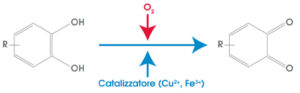
Enzymatic oxidation or polyphenol oxidase (PPO) by grape enzymes (tyrosinase) or molds (Botrytis cinerea and Laccase), transforms phenolic compounds (flavan-3-ols, caffeine-oil-tartaric acid, etc.) into quinones, causing enzymatic browning.
In healthy grapes, tyrosinase is the main enzyme involved in browning reactions.
Sulfur dioxide works by reducing the activity of the degenerative enzyme tyrosinase (polyphenol oxidase) present in the must (browning).
It can also be eliminated with clarification or hyper-oxygenation
Laccase, on the other hand, produced by Botrytis cinerea, is not very sensitive to either bentonite treatments or sulphite additions, and therefore constitutes a big problem for producers.
During winemaking, PPO activity decreases in relation to the formation of alcohol, the decrease in pH and the precipitation of proteins.
These phenolic reactions, both enzymatic and non-enzymatic, result in the formation of secondary products called quinones which are directly involved in all oxidation processes.
Exacta+Optech at the CREA 2024 event
Exacta + Optech participated in and sponsored the conference Research at the service of the quality and longevity of wine, held in Rosignano Monferrato (AL) at the Castello di Uviglie – Località Castello di Uviglie 73 – Wednesday 10 April 2024.
The initiative, organized by CREA, focused on the evolution of the polyphenolic composition of Barbera and Nebbiolo grapes, with the presentation of the results of the three-year QUALSHELL project. The program included high-profile scientific contributions:
- Antonella Bosso — Evolution of the main polyphenolic compounds in grape skins at the end of ripening (CREA-VE, Asti)
- Simone Giacosa — Analysis of grape phenolic maturity (DISAFA, University of Turin)
- Andrea M. Rossi — Raman spectroscopy for polyphenolic monitoring (INRiM)
- Milena Lambri — Current winemaking trends induced by climate change (Catholic University)
The day was divided into key moments:
- Guided tour of the cellars of Castello di Uviglie
- Technical-scientific conference, introduced by Daniela Pesce – President of the Piedmont and Aosta Valley Wine Association
- Guided tasting of the wines studied in the research, led by oenologist Marco Santarelli
- Concluding aperitif
The official event poster is available for download, along with photos dedicated to the event.
Photo gallery


SO2 and O2 Oxidation and Protection Processes
So2 in Oenology
Oxidation is the term used by chemists to describe when an element or compound loses electrons; oxygen is often involved in this process because it readily accepts one or more electrons when it reacts with an element or compound.
We have seen that oxidation during grape harvesting is of an enzymatic type while in subsequent processes it is of a non-enzymatic or chemical type.
SO2 acts as an inhibitor on the chemical oxidations of phenolic substances which, if not properly protected, oxidize, compromising the colouring substances, tannins, aromatic substances and therefore the organoleptic quality of the wine.
The risk increases with the presence of powerful reaction catalysts such as metal ions of copper and iron.
So2 is used in viticulture to prevent these oxidations but it does not act directly by eliminating oxygen from wines and musts: although the sulfite ion (So3 2 – ) can bind to oxygen, there is practically no sulfite ion in solution in the pH range found in wine.
To fully understand the interactions between polyphenols and O2, it is necessary to study the chemical reactions that occur during this process.
 Continue reading →
We have seen that oxidation during grape harvesting is of an enzymatic type while in subsequent processes it is of a non-enzymatic or chemical type.
SO2 acts as an inhibitor on the chemical oxidations of phenolic substances which, if not properly protected, oxidize, compromising the colouring substances, tannins, aromatic substances and therefore the organoleptic quality of the wine.
The risk increases with the presence of powerful reaction catalysts such as metal ions of copper and iron.
So2 is used in viticulture to prevent these oxidations but it does not act directly by eliminating oxygen from wines and musts: although the sulfite ion (So3 2 – ) can bind to oxygen, there is practically no sulfite ion in solution in the pH range found in wine.
To fully understand the interactions between polyphenols and O2, it is necessary to study the chemical reactions that occur during this process.
Continue reading →The antimicrobial power of SO2 in oenology
So2 in Oenology

Sulfur dioxide is effective against both bacteria and yeasts: its antiseptic power depends fundamentally on the concentration in its molecular form.
During fermentation, some yeasts and many bacteria are more sensitive than others to the effects of SO2, so an important selection process takes place.
In the right concentration, SO2 in musts and wines prevents the growth of unwanted yeasts and bacteria such as Brettanomyces, Pediococci and Lactobacilli acetic bacteria and keeps selected ones such as Saccharomyces active.
The enzyme, produced by Botrytis cinerea present in moldy grapes, is less sensitive to sulphites.
To neutralize yeasts in wine, small quantities of molecular SO2 are sufficient because another powerful antiseptic comes into play: alcohol.
In refining, its antiseptic activity depends on the concentration in the molecular form and Bisulphite Ion therefore on the pH, temperature and alcohol.
During storage, SO2 inhibits all microorganisms, thus avoiding unwanted refermentations or revitalization of yeasts in the bottle. Continue reading →